
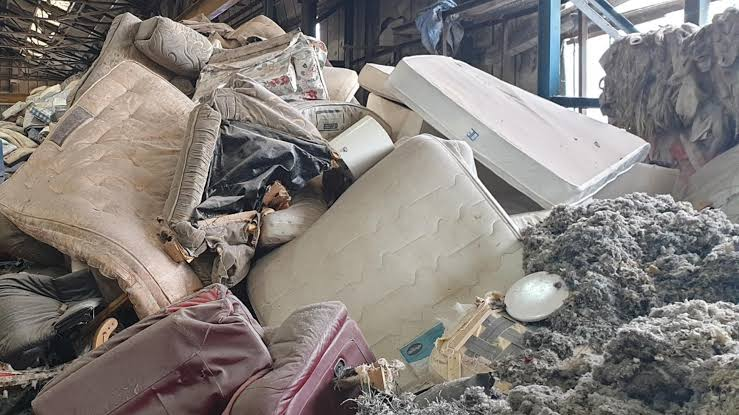
Every year, Australians discard an estimated 1.8 million mattresses. That figure gets quoted often, but what does it actually represent? How much of that volume ends up in landfill, and how does mattress waste in Australia compare to the country’s other bulky waste challenges?
The answers matter. The Australia mattress disposal problem is not just an environmental talking point. It is a measurable infrastructure gap between the number of mattresses reaching end of life and the capacity available to deal with them responsibly. This article breaks down the mattress waste statistics Australia needs to confront, drawing on verified data from the National Waste Report, the ABSC and industry research.
How Many Mattresses Are Thrown Away in Australia Each Year?
The most widely cited figure comes from the Australian Bedding Stewardship Council (ABSC) and Planet Ark: approximately 1.8 million mattresses are disposed of annually across the country. The ABSC is the industry body working to move bedding toward a circular economy, and this estimate reflects both residential and commercial disposal volumes nationally.
It is worth understanding how many mattresses are thrown away in Australia in physical terms, not just as a number on a page. A standard queen mattress is roughly two metres long. Laid end to end, 1.8 million mattresses would stretch from Darwin to Hobart. Each one takes up around 0.75 cubic metres of space, which means the annual total occupies approximately 1.35 million cubic metres of volume. That is a lot of recoverable material entering the waste stream year after year.
These are not lightweight items either. A queen mattress weighs between 25 and 40 kilograms, so the collective weight of 1.8 million discarded mattresses works out to roughly 45,000 to 72,000 tonnes annually based on that range.
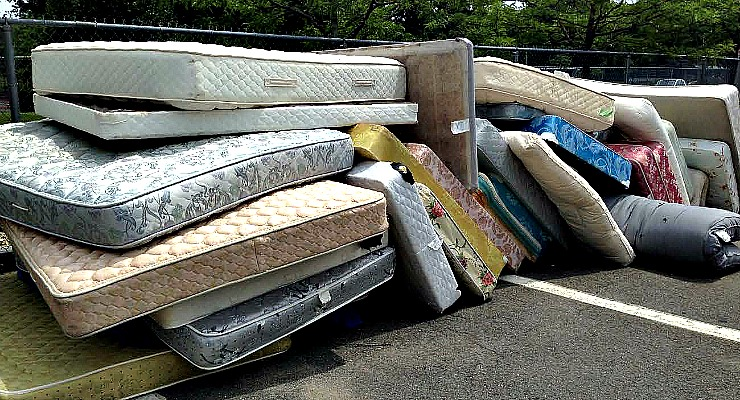
Where Do Australia’s Discarded Mattresses End Up?
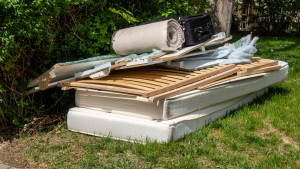
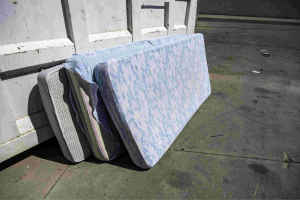
Most of them go to landfill. According to the Mattresses Matter survey report (Soft Landing, 2024), the numbers break down like this:
- 740,000 mattresses (of the 1.8 million discarded each year) are sent directly to landfill, roughly 22,000 tonnes of waste that could have been diverted
- An additional 15,000 tonnes of mattress material still ends up in landfill even after recycling, because not all components can currently be processed in Australia
- Combined, that puts the real landfill toll from mattress disposal at closer to 37,000 tonnes per year
- The gap in that second point matters. Memory foam has a limited domestic recycling market, and the shredded mix of foam and fabric (known as “floc”) often has nowhere to go except the tip. Mattress landfill in Australia is not just about the mattresses that never reach a recycler. It is also about what happens after they do.
- Mattresses do not break down the way organic waste does. Their mixed materials (steel, foam and treated fabric) can sit in landfill for decades, occupying space the entire time without breaking down into anything useful.
Mattress Waste Australia vs Other Bulky Waste Streams
To understand the scale of mattress waste in Australia, it helps to see it alongside the country’s broader waste profile.
In 2020/21, Australia generated an estimated 75.8 million tonnes of total waste, equivalent to 2.95 tonnes per person. The largest categories were:
- Building and demolition materials: 25.1 Mt
- Organics: 14.4 Mt
- Ash: 12.0 Mt
- Hazardous waste: 7.4 Mt
- At somewhere between 45,000 and 72,000 tonnes, mattress waste does not rival these categories in raw tonnage. But mattresses are one of the most problematic items within the household waste stream because of their size, their mixed materials, and the limited infrastructure available to process them. The National Waste Report does not break out mattress data as a standalone category, which makes the ABSC’s work in tracking these numbers particularly important.
- Australia’s overall resource recovery rate reached 66% in 2022/23, up from 60% in 2020/21. The mattress recycling rate in Australia lags well behind the national average, highlighting how far this specific category still has to go. Metals sit at 90% recovery. Mattresses, with their mix of steel, foam, fabric and timber, are nowhere close.
Mattress Recycling Infrastructure in Australia
What Recycling Actually Recovers
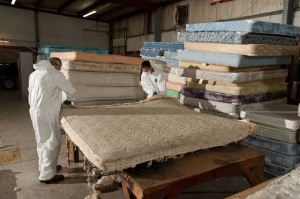
When a mattress reaches a recycling facility, it is either manually dismantled or mechanically shredded. The difference in outcomes between these two methods is significant.
According to the Mattresses Matter survey report (Soft Landing, 2024), manual dismantling recovers around 70% of a mattress’s materials. Steel springs, foam, timber and fabric are separated and directed to their respective recycling streams. Shredding, by contrast, recovers only about 40%, primarily the steel. The remaining floc, a mix of foam and textiles, has limited value and typically goes to landfill.
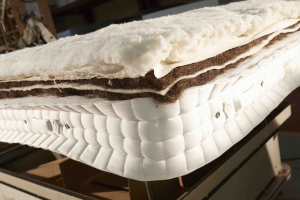
The shift toward pocket spring mattresses in recent years has made things harder. Unlike traditional Bonnell coils, pocket springs are individually wrapped in fabric, which makes clean steel recovery more difficult and more expensive. The ABSC has described this as an “equipment gap”, noting that much of Australia’s current mattress recycling infrastructure was not built to handle the volume of pocket springs now entering the waste stream.
Why Regional Facilities Are Closing
Mattress recycling infrastructure in Australia is concentrated in major metro areas, leaving regional and remote communities with far fewer options. In mid-2026, the ABSC documented the closure of a dedicated mattress recycling facility in regional Queensland, a sign that individual towns and shires simply don’t generate enough volume to sustain a standalone processing operation.
The ABSC’s proposed fix is a hub-and-spoke model:
- Regional councils pool volumes instead of each town running its own facility
- Shared infrastructure serves multiple areas rather than one isolated site
- Funding and coordinating that network takes time. Until it exists, the gap between where mattresses are discarded and where they can be recycled keeps growing.
- At our Melbourne facility, we see this gap firsthand. Mattresses arrive from across Victoria, including areas with no local recycling option, and demand consistently outpaces what the current network can absorb.
Solving Mattress Waste in Australia Starts with Better Disposal Choices
Put together, the numbers tell a consistent story: not enough recycling infrastructure, not enough material recovery, and far too much ending up in landfill. Mattress waste in Australia is a quantifiable problem with a documented infrastructure gap. The 1.8 million mattresses discarded each year are not all reaching recyclers, and even those that do are not being fully recovered.
That is why our Mission Zero goal, 100% recycling by 2030, is grounded in operational reality rather than marketing language. Every mattress we collect at The Mattress Recycling Company is either deconstructed for material recovery or refurbished and donated to people in need through our Love Not Landfill program. Our belief is simple: Solution Not Pollution. That specificity is what separates a genuine recycling commitment from a marketing line.
If you have a mattress to get rid of, choosing a dedicated recycling service over council hard rubbish or illegal dumping is one of the simplest ways to keep mattress waste out of landfill. Our mattress disposal service covers Melbourne, Geelong, Ararat, Brisbane, Ballarat, Horsham, the Gold Coast and the Sunshine Coast, with same-day collection available when you book before 10 am. You can get an instant upfront price and book online in a few minutes.